

Software Discovery Workshop Singapore: Scope Before You Build
Most expensive software problems in Singapore start the same way: a company jumps into development with a feature list and a hopeful deadline.
A software discovery workshop exists to prevent that. It turns vague ambition into a buildable version-one scope, with process clarity, constraints, risks, and a delivery plan a business can actually fund.
This guide explains what a strong discovery workshop should include, who should attend, what artefacts you should leave with, and how discovery connects to choosing a software development company in Singapore. It complements our choose-partner guides without replacing them: how to choose a software company in Singapore 2026 and how to choose a software development company Singapore.
SectionWhy Discovery Matters More Than a Fancy Proposal
A proposal without discovery is often a polished guess.
Discovery answers:
- What operational outcome are we buying?
- Who will use this daily?
- Which process is in scope for version one?
- What systems must integrate?
- What can wait?
- What would make this project fail?
If those answers are fuzzy, estimates are theatre.
SectionWho Should Run a Discovery Workshop
Good candidates:
- SMEs replacing spreadsheets and WhatsApp workflows
- companies planning custom ERP or operations software
- teams preparing an EDG-oriented digitisation scope
- founders validating an MVP before heavier spend
- enterprises aligning stakeholders before vendor selection
If you already have a detailed process bible, clean data model, and frozen MVP, you may need a shorter technical inception instead of a full workshop. Most teams do not.
SectionWhat a Strong Discovery Workshop Produces
At minimum, you should leave with:
- outcome statement and success metrics
- as-is / to-be process maps for version one
- user roles and permission assumptions
- integration list with masters ownership
- MVP scope and explicit defer list
- risks and open decisions
- phased roadmap
- budget and timeline confidence ranges
If a workshop only produces sticky notes and vibes, it failed.
SectionRecommended Workshop Structure
A practical Singapore format is 1 to 3 sessions, depending on complexity.
Session 1: Goals and constraints
Agenda:
- business context and urgency
- what "success in 90 days after launch" looks like
- budget envelope and non-negotiable dates
- compliance, audit, or customer constraints
- systems that cannot be replaced yet
Output:
- outcome statement
- constraint register
- stakeholder map
Session 2: Process deep-dive
Agenda:
- walk the real workflow with the people who do it
- identify handoffs, delays, and exception paths
- separate policy rules from tool workarounds
- capture reporting needs from managers
Output:
- as-is map
- to-be version-one map
- exception catalogue
Session 3: Scope freeze and delivery shape
Agenda:
- define MVP boundaries
- prioritise integrations
- choose phased releases
- estimate confidence ranges
- assign owners for open decisions
Output:
- MVP backlog themes
- defer list
- delivery plan
- rough commercial range
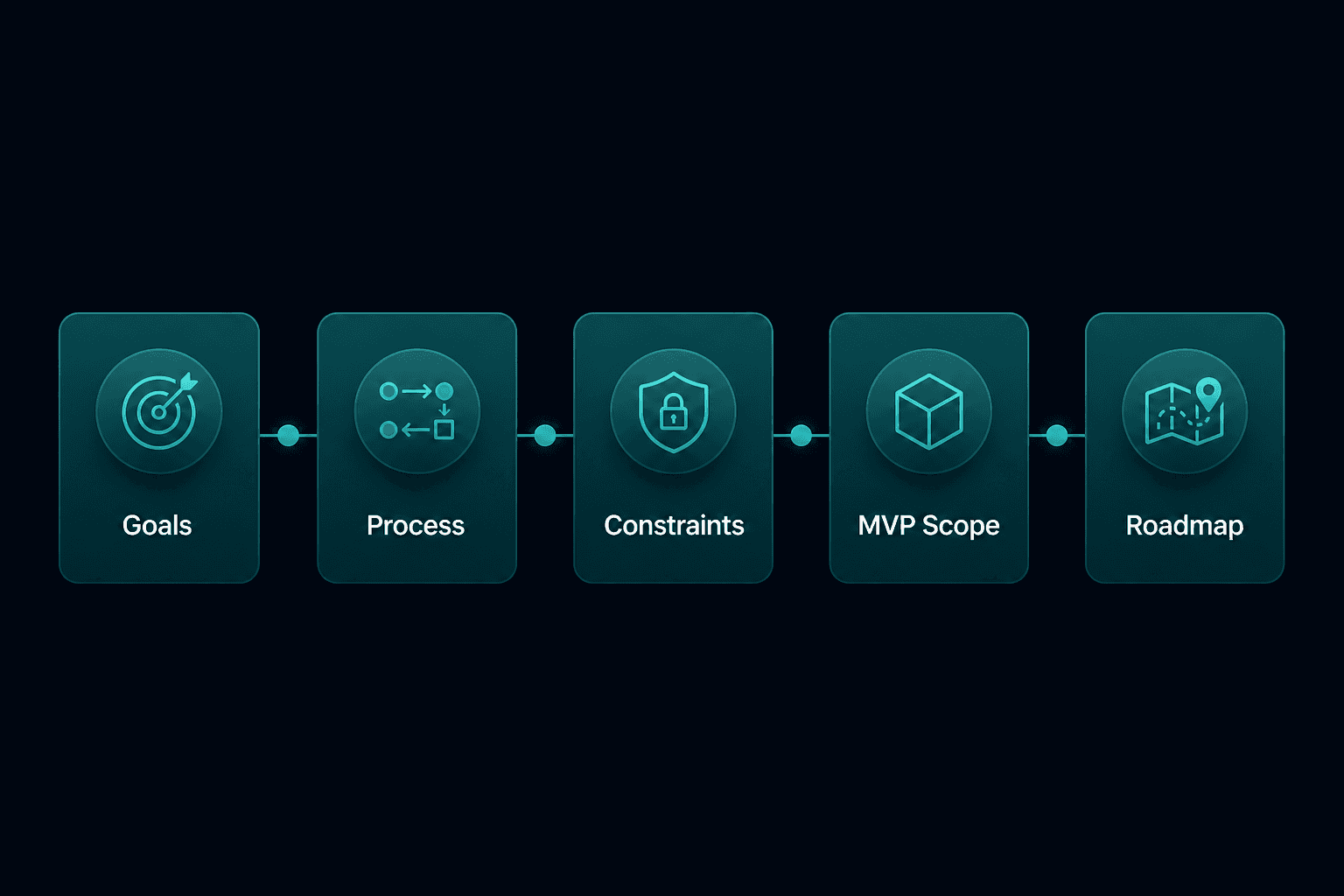
SectionThe Five Discovery Lenses
1. Goals
Translate goals into measurable operations language.
Weak: "digitise the business"
Stronger:
- reduce quotation turnaround from 3 days to same day
- improve stock accuracy above 95%
- cut month-end close by 5 days
- remove double entry between sales and accounting
2. Process
Map one vertical slice end-to-end. Do not boil the ocean.
Example slices:
- enquiry → quote → job → invoice
- PO → receive → stock → fulfil
- ticket → assign → resolve → close
3. Constraints
Capture:
- budget ceiling
- go-live pressures
- EDG timing if relevant
- must-keep systems
- security and access needs
- offline / mobile requirements
4. MVP scope
MVP is the smallest system that changes a costly workflow.
Not:
- every department dashboard
- every edge-case automation
- a redesign of the whole company operating model
Yes:
- one primary workflow
- the roles that run it
- the integrations required for that workflow to be real
5. Roadmap
Version two and three should exist as intent, not as hidden scope inside version one.
SectionArtefacts Template You Can Reuse
Outcome one-pager
- problem
- users
- success metrics
- non-goals
Process board
- trigger
- steps
- systems touched
- approvals
- failure paths
Integration matrix
For each system:
- data exchanged
- direction
- master
- timing
- owner
Scope card
- in
- out
- later
- unresolved
Risk register
- risk
- impact
- likelihood
- mitigation
- owner
SectionCommon Discovery Mistakes
Feature shopping too early
Screens before process creates pretty wrong software.
Only managers in the room
Managers describe the ideal process. Staff reveal the real one.
No defer list
If everything is "important", nothing is scoped.
Fake certainty on estimates
Discovery should improve estimate confidence. It should not pretend uncertainty vanished.
Skipping integration talk
Integrations are where timelines hide. Surface them early. See API integration services Singapore and accounting software integration Singapore.
SectionDiscovery for Different Project Types
Custom ERP / operations platform
Focus on module sequencing, master data, and cutover risks. Pair with ERP implementation Singapore checklist and custom ERP development Singapore.
Mobile / field apps
Focus on offline needs, role UX, and what must be captured on site. Related: hire app developer Singapore 2026 and MVP app development Singapore guide.
AI operations agents
Focus on allowed actions, escalation policy, and evaluation cases. Related: AI agents for business operations Singapore and AI readiness assessment Singapore.
Replacement of legacy systems
Focus on data migration, parity myths, and which reports are truly needed.
SectionHow Discovery Changes Vendor Selection
After discovery, you can evaluate partners on substance:
- Did they challenge weak requirements?
- Did they force prioritisation?
- Did they surface integration and data risks?
- Did they separate MVP from wishlist?
- Are estimates tied to scoped outcomes?
This is more useful than comparing logo slides. For partner criteria, use how to choose a software company in Singapore 2026.
SectionCost and Duration of Discovery
Typical Singapore ranges:
Lightweight discovery
S$2,000 to S$6,000 · 3 to 10 days elapsed
Best for focused MVPs and single-workflow tools.
Standard discovery
S$6,000 to S$15,000 · 1 to 3 weeks
Best for multi-role operations systems with integrations.
Deep discovery / inception
S$15,000 to S$30,000+ · 2 to 5 weeks
Best for ERP-scale or multi-department transformations.
Discovery fees are usually small compared with the cost of building the wrong thing. Many teams apply discovery output directly into EDG-oriented project framing; see EDG grant software development Singapore.
SectionWhat Happens After the Workshop
A healthy next sequence:
- confirm open decisions
- issue scoped proposal / statement of work
- validate estimate assumptions
- start phased build
- keep change control tied to the discovery defer list
If a vendor wants to discard discovery artefacts and "just start coding", treat that as a warning signal.
SectionSample Agenda Pack for a One-Day Discovery
If your project is focused enough for a single intensive day:
Morning
- 60 minutes: outcomes, constraints, success metrics
- 90 minutes: as-is process walkthrough with operators
- 30 minutes: systems and integration inventory
Afternoon
- 90 minutes: to-be version-one design and exception handling
- 45 minutes: MVP in/out prioritisation
- 45 minutes: risks, open decisions, roadmap, and estimate assumptions
Send pre-work one week earlier: current screenshots, sample documents, org roles, and a short list of "top 10 daily pains". Workshops go faster when participants arrive with evidence, not only opinions.
SectionHow SleekDigital Runs Discovery
As a software development company in Singapore, our discovery style is practical:
- outcome first, features second
- real process mapping with operators
- ruthless version-one boundaries
- integration and data risks made visible early
- roadmap that protects budget from silent scope creep
We use discovery to make custom software development projects commercially sane before engineering velocity becomes expensive.
If speed of delivery after scope freeze matters, see how we run AI-assisted development.
SectionFAQ: Software Discovery Workshop Singapore
Is discovery just for big enterprise projects?
No. SMEs often need it more because they have less budget to waste on wrong builds.
Can we skip discovery if we already have a feature list?
A feature list is not a process model. You can shorten discovery, but skipping it entirely is how feature lists become rewrite projects.
Who must attend?
At least: executive sponsor, business owner, and one practitioner per core workflow. Add finance/IT when integrations or compliance matter.
Will discovery give an exact fixed price?
It should give a much tighter range and clearer assumptions. Exactness depends on remaining unknowns, especially third-party systems and data quality.
Do we own the discovery outputs?
Yes. You should leave with documents you can reuse with any competent delivery partner.
SectionFinal Pre-Build Checklist
Before development kickoff, confirm you have:
- written outcomes and metrics
- version-one process map
- MVP in/out list
- integration matrix
- risk register
- named decision owner
- budget/timeline confidence range
If any are missing, keep discovering.
Book a software discovery conversation with SleekDigital →
Or start from our software development company Singapore page and custom software development overview.
Written by
Lester Law
Building custom software solutions for Singapore businesses. We help companies transform their operations with mobile apps, web platforms, and enterprise systems.