

Accounting Software Integration Singapore: Stop the Double Entry Loop
If your team re-enters invoices from a sales system into accounting every week, you do not have an accounting problem. You have an accounting software integration problem.
This guide explains how Singapore businesses should approach accounting integrations with platforms like Xero and QuickBooks, or with a custom ERP finance module. It strengthens the same commercial intent as our API integration services Singapore and custom software development work: clean data flow, fewer manual steps, trustworthy books.
SectionWhy Accounting Integration Matters More Than Another Dashboard
Finance is where operational mistakes become expensive.
Without integration:
- sales invoices are typed twice
- inventory COGS is guessed
- payment status is stale
- GST coding is inconsistent
- month-end becomes detective work
With the right integration:
- operational systems create draft or posted accounting entries by rule
- finance reviews exceptions instead of rekeying everything
- management reports reconcile to the ledger faster
The goal is not "connect everything". The goal is a reliable handoff between operations and finance.
SectionCommon Integration Patterns in Singapore
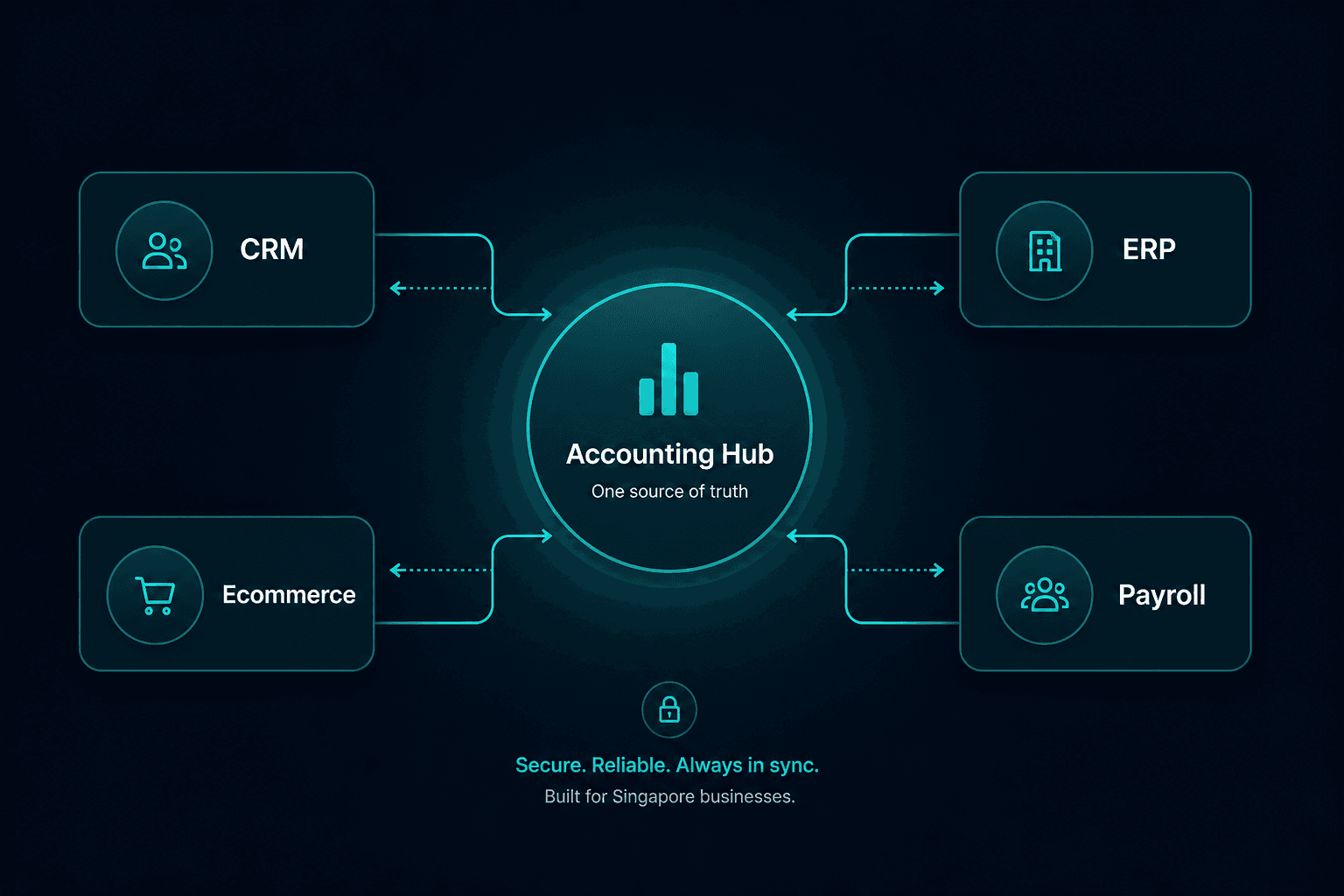
Pattern A: Packaged accounting as system of record
Typical stack:
- Xero or QuickBooks Online for ledger
- CRM / sales tool for pipeline
- inventory or ops app for fulfilment
- payroll tool for salaries
Integration pushes invoices, bills, payments, and contacts into accounting. Accounting remains master for the ledger.
Best for SMEs that want a known accounting product and lighter custom finance logic.
Pattern B: Custom ERP with accounting module
Operations and finance live in one platform, sometimes still syncing to an external accountant-preferred tool for statutory filing or advisory workflows.
Best when approvals, inventory, project costing, or multi-branch rules are too specific for packaged tools. See ERP software Singapore and ERP system cost Singapore 2026.
Pattern C: Hybrid
Custom ops system handles industry workflows. Packaged accounting remains the ledger. A middleware or API layer synchronises documents and statuses both ways where needed.
This is the most common serious SME pattern we see in Singapore.
SectionWhat Should Sync (and What Should Not)
Usually sync
- customers and suppliers (with clear master ownership)
- invoices and credit notes
- bills and purchase invoices
- payments and payment allocations
- chart of accounts mapping
- tax codes / GST treatment
- products or items used on invoices
- project or cost-centre codes if used in reporting
Sync carefully or not at all
- historical clutter contacts
- every CRM lead that never became a customer
- inventory movements that finance does not book individually
- draft quotes that are not commercial documents yet
- chatty status events that create noise, not journal truth
Over-syncing is a common failure mode. More events is not more control.
SectionMaster Data Rules You Must Decide Early
Integration quality is mostly master-data quality.
Decide:
- Which system owns customer creation?
- Which system owns item codes and pricing?
- Who can edit bank details?
- What happens when a contact exists in both systems with different names?
- How are multi-entity or multi-currency records handled?
Write these rules down before anyone writes mapping code.
SectionGST and Singapore-Specific Considerations
Accounting integration in Singapore is not only "create invoice API call".
Plan for:
- correct GST codes on line items
- inclusive vs exclusive tax handling
- credit note behaviour
- export / zero-rated scenarios where relevant
- invoice numbering and audit trail expectations
- accountant review workflows before period lock
If finance cannot explain the GST treatment of an automated entry, do not automate that entry yet.
SectionIntegration Design Checklist
1. Document the commercial workflow
Example sales flow:
- quote approved
- delivery completed
- invoice issued
- payment collected
- revenue recognised / reconciled
Only some of those steps should create accounting documents.
2. Define the accounting event
For each operational event, specify:
- document type created
- timing (immediate, daily batch, on approval)
- draft vs posted
- who can edit after sync
- idempotency key (to prevent duplicates)
3. Map fields explicitly
Do not rely on "similar names".
Map:
- contact identifiers
- account codes
- tax codes
- tracking categories / classes / locations
- item codes
- payment methods
4. Design failure handling
Assume APIs fail.
You need:
- retry strategy
- dead-letter queue or failed-sync inbox
- alerting for finance/ops
- replay tools
- reconciliation reports
Silent failed syncs are worse than no sync.
5. Build reconciliation into the product
A weekly "what did not match" report is not optional.
Include:
- invoices in ops missing in accounting
- invoices in accounting missing source documents
- amount mismatches
- contact duplicates created by sync
SectionXero and QuickBooks Integration Notes
Xero
Common strengths for Singapore SMEs:
- accountant familiarity
- solid invoicing and bank reconciliation workflows
- API ecosystem maturity
Watch-outs:
- rate limits and API pagination design
- careful handling of updates vs creates
- inventory depth may still need an ops system beside Xero
QuickBooks Online
Common strengths:
- familiar UI for many finance users
- useful for smaller entities and straightforward ledgers
Watch-outs:
- confirm Singapore tax setup with your accountant
- do not assume every local workflow maps cleanly to US-centric defaults
- keep custom fields and tracking disciplined
Neither platform removes the need for process design. They amplify the process you encode.
SectionInventory, Sales, and Payroll Touchpoints
Inventory and COGS
If you sell physical goods, decide whether accounting receives:
- summary journals
- invoice-level product detail
- or both
Warehouse truth often belongs in an inventory system. Ledger truth belongs in accounting. Integration should respect that boundary. Related reading: inventory management software Singapore and wholesale distribution software Singapore.
Sales and CRM
CRM should not become a second ledger.
Usually:
- CRM owns pipeline
- ops/ERP owns fulfilment documents
- accounting owns posted financial documents
Payroll
Payroll tools often remain separate. Integration may push:
- salary journals
- CPF-related postings (with accountant-approved mapping)
- employee expense reimbursements
Do not invent payroll accounting logic in a sales app.
SectionBuild vs Middleware vs Native Connectors
Native connector
Use when the use case is standard and the connector is trustworthy.
Risk: limited custom rules, brittle edge cases.
iPaaS / middleware
Use when you need visibility, retries, and multi-app orchestration without building all plumbing.
Risk: monthly cost and complexity can grow quietly.
Custom API integration
Use when:
- rules are specific
- volumes are meaningful
- auditability matters
- packaged connectors cannot express your workflow
This is core work in our API integration services Singapore and broader custom software development projects.
SectionCost and Timeline Ranges
Planning bands for Singapore SMEs:
Single-direction invoice sync
About S$8,000 to S$25,000
One operational system to Xero/QuickBooks for invoices/contacts, with basic error handling.
Timeline: 2 to 6 weeks.
Bidirectional ops-accounting integration
About S$25,000 to S$70,000
Includes payments status, item mapping, failed-sync console, and reconciliation reports.
Timeline: 6 to 12 weeks.
ERP-grade finance integration layer
About S$70,000+
Multi-entity, inventory journals, approvals, and deeper exception workflows.
Timeline: 3 to 6 months depending on scope.
Costs rise with dirty master data, unclear ownership, and "sync everything" ambitions.
SectionEDG and Digitization Framing
For qualifying SMEs, accounting integration that reduces manual re-entry and improves process reliability can sit inside a broader digitisation scope. Grant conversations are stronger when outcomes are measurable:
- hours removed from month-end
- invoice rekeying eliminated
- reconciliation exceptions reduced
See EDG grant software development Singapore.
SectionImplementation Sequence We Recommend
- Freeze the accounting event model with finance
- Clean customer/supplier/item masters
- Integrate one document type end-to-end (usually sales invoices)
- Add exception inbox and reconciliation
- Expand to bills, payments, or inventory journals
- Only then automate more posting autonomy
This mirrors the phased discipline in our ERP implementation Singapore checklist.
SectionHow SleekDigital Helps
As a software development company in Singapore, we:
- map the finance handoff before writing connectors
- choose packaged accounting vs custom ERP finance intentionally
- build idempotent syncs with failure visibility
- give finance a review workflow instead of blind automation
We optimise for books you can trust at month-end, not just a green "connected" badge.
SectionFAQ: Accounting Software Integration Singapore
Should Xero/QuickBooks be replaced by custom ERP?
Not by default. Keep packaged accounting if it serves finance well and integrate operations into it. Move finance into custom ERP when process complexity and control needs exceed the package.
Can we sync in real time?
Often yes for creates and status updates. Many teams still prefer batched posting for finance control. Real-time is a design choice, not a virtue by itself.
Who should own the integration: finance or IT?
Finance owns accounting truth. Operations owns source workflows. A joint owner must approve mappings and exception policy.
What is the biggest integration risk?
Duplicate documents from weak idempotency and unclear masters. Second biggest: silent failures nobody monitors.
Do we need to migrate all history?
Usually migrate opening balances and essential open items first. Historical clutter can stay archived unless there is a hard reporting need.
SectionFinal Take
Accounting software integration in Singapore succeeds when you treat it as financial process design with APIs attached.
If your team is still copy-pasting invoices between systems, talk to SleekDigital about a scoped integration plan. Start from our API integration services Singapore page or custom software development overview.
Written by
Lester Law
Building custom software solutions for Singapore businesses. We help companies transform their operations with mobile apps, web platforms, and enterprise systems.