

AI Agents for Business Operations Singapore: Practical Use Cases
AI agents for business operations in Singapore are moving from demos into daily work. The useful question is no longer "can AI write an email?" It is "which operational tasks can an agent complete safely, with clear escalation, inside the systems we already run?"
This guide is for Singapore SMEs and mid-market teams that want operational leverage without pretending a chatbot is a transformation strategy. It sits beside our AI development Singapore and AI-native transformation Singapore pages. If you are evaluating a full AI-native ERP layer, use our AI ERP Singapore service or the AI-native ERP explainer. This article focuses on operations agents that can ship in phases.
SectionWhat an Operations AI Agent Actually Is
An operations agent is software that can:
- observe inputs (emails, forms, tickets, documents, system events)
- decide next actions using rules plus model reasoning
- act inside tools (create records, draft replies, update statuses)
- escalate when confidence is low or risk is high
- leave an audit trail humans can review
It is not a generic chat window bolted onto your website.
If the agent cannot take a bounded action in a real workflow, you have a content toy, not an operations asset.
SectionWho Should Care Right Now
Strong fit:
- teams drowning in repetitive coordination work
- businesses with high document volume (quotes, invoices, POs, claims)
- support or ops teams with predictable ticket patterns
- companies with clean-enough systems of record to act against
Weak fit (for now):
- businesses with no process ownership
- environments where every exception is unique and undocumented
- teams hoping AI will replace the need to define workflow
AI accelerates defined work. It amplifies undefined work.
SectionThe Capture → Decide → Act → Escalate → Learn Loop
Every serious operations agent should follow a closed loop.
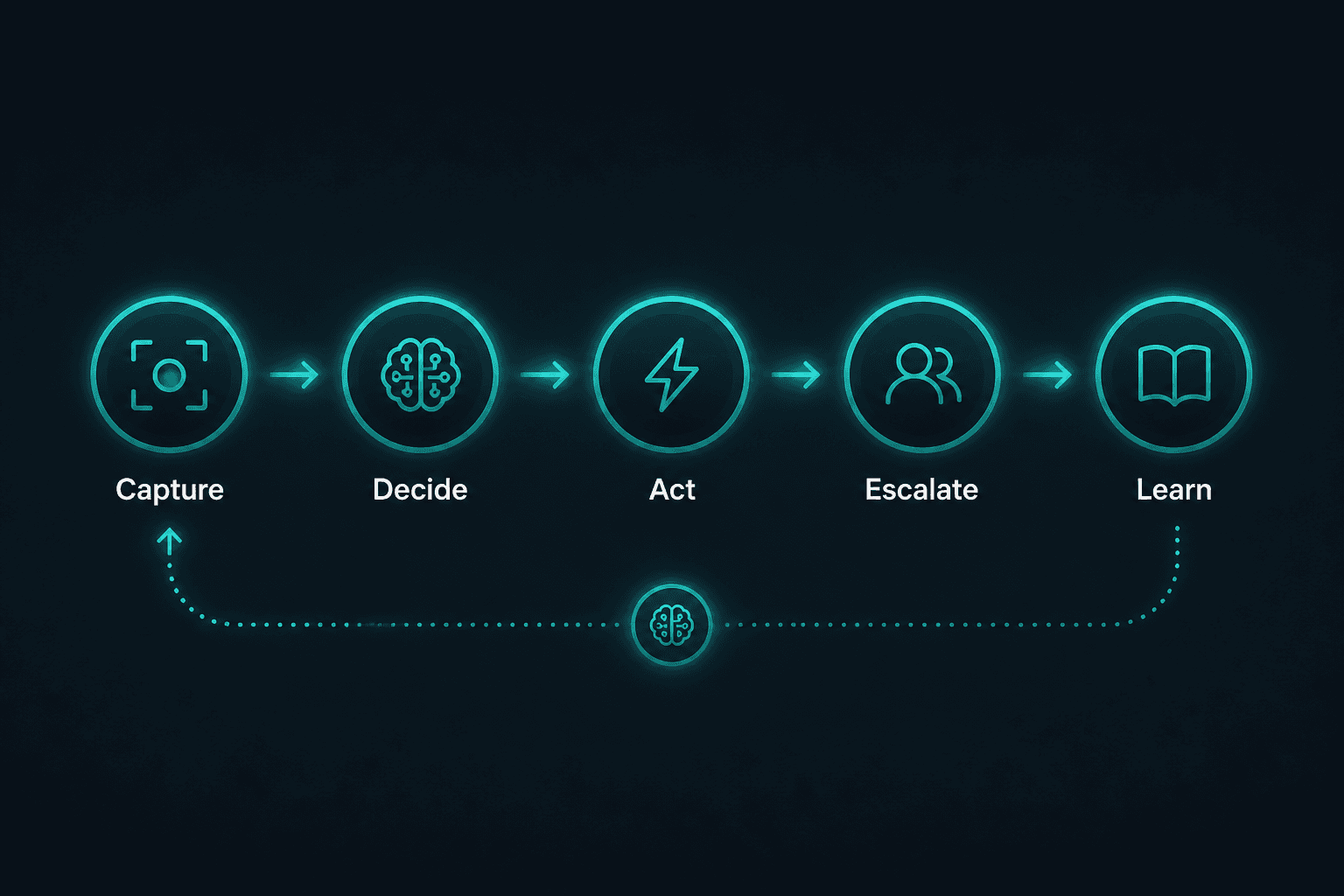
Capture
Inputs can include:
- inbound email and attachments
- WhatsApp or web form submissions
- ERP or CRM events
- OCR from PDFs and images
- sensor or schedule triggers
Decide
Decision layers usually combine:
- hard business rules (credit limits, approval thresholds)
- retrieval from company knowledge (policies, SKUs, price lists)
- model reasoning for classification and drafting
- confidence scoring
Act
Useful actions:
- create or update CRM/ERP records
- draft customer replies for human send
- assign tickets
- generate task checklists
- trigger procurement or follow-up reminders
Escalate
Escalation is not failure. It is design.
Escalate when:
- confidence is below threshold
- amount or risk exceeds policy
- customer is VIP / contractual exception
- required data is missing
- action would be irreversible
Learn
Learning should be controlled:
- human corrections become examples
- prompt and policy updates are versioned
- outcome metrics are reviewed weekly
Unsupervised "self-learning" in finance or fulfilment is how you get silent errors.
SectionHigh-ROI Use Cases for Singapore Businesses
1. Quotation and enquiry triage
An agent can:
- classify inbound enquiries by product line
- extract requirements from emails
- draft first-pass quotations from approved price logic
- flag non-standard requests to sales
Best when price lists and constraints are structured. Weak when every quote is bespoke negotiation from minute one. For the distributor-specific first ship (messy RFQ to approved draft, one workflow only), use AI quotation agent for Singapore wholesale distributors.
2. Document processing operations
Common documents:
- supplier invoices
- delivery orders
- contracts and onboarding packs
- claim forms
- KYC packs in regulated workflows
The agent extracts fields, validates against purchase orders, and routes exceptions. Humans handle mismatches.
3. Customer support operations triage
Not "replace support". Triage and preparation:
- classify ticket intent
- pull account context
- suggest reply drafts
- route to the right queue
- detect churn-risk language
This pairs well with AI chatbot development Singapore when chat is a channel, but the agent value is in the operations backbone behind the channel.
4. Inventory and exception monitoring
Agents can watch for:
- stock below reorder thresholds
- unusual order spikes
- failed sync jobs
- delayed fulfilment milestones
Then create tasks, notify owners, or draft purchase recommendations. For deeper stock systems, see inventory management software Singapore.
5. Internal ops copilots for managers
Examples:
- weekly ops digest from multiple systems
- "what is blocked today" summaries
- policy Q&A for staff with citations
- checklist generation for recurring processes
These are lower risk because they advise more than they mutate.
SectionWhat Not to Automate First
Avoid starting with:
- final legal commitments
- irreversible financial postings without approval
- ambiguous HR decisions
- anything your team cannot currently explain as a process
Start where volume is high, rules are partially explicit, and mistakes are recoverable.
SectionArchitecture Building Blocks
A practical Singapore ops-agent stack usually includes:
- System of record: ERP, CRM, helpdesk, or custom ops app
- Integration layer: APIs, webhooks, queues
- Retrieval layer: policies, SKUs, SOPs, historical tickets
- Agent runtime: tools, permissions, memory boundaries
- Human review UI: approve / edit / reject actions
- Observability: logs, traces, evaluation sets
If your systems do not talk to each other yet, fix integration foundations first. Our API integration services Singapore guide covers that layer. For custom platforms, see custom software development.
SectionGovernance That Singapore Teams Actually Need
For a printable gate (who approves, forbidden writes, review UI, logs), use the human-in-the-loop AI approval checklist. The commercial build is AI agents Singapore.
Permissioning
Agents should act with least privilege:
- read-only where possible
- write access only to approved objects
- no broad admin credentials in prompts or configs
Auditability
Log:
- input received
- tools called
- decision rationale summary
- confidence
- human overrides
Data handling
Be explicit about:
- customer PII
- where prompts are processed
- retention of transcripts
- vendor subprocessors
This matters for trust with enterprise customers and for internal compliance culture.
Evaluation before scale
Before wide rollout, test against a fixed set of historical cases:
- accuracy of classification
- hallucination / wrong field extraction rate
- escalation precision
- time saved per case
- user acceptance
SectionBuild vs Buy for Operations Agents
Buy when
- the workflow is standard (generic ticket triage)
- vendor connectors already match your stack
- you need speed for a narrow use case
Build when
- your process is a competitive advantage
- data models are specific
- you need deep ERP/CRM actions
- packaged tools force awkward workarounds
Many Singapore teams land on a hybrid: packaged model infrastructure plus custom tools and workflow logic. That is the same pattern we use in AI development Singapore engagements.
If you are still in strategy mode, our AI readiness assessment Singapore and AI consulting Singapore guide help sequence the decision. For build-versus-buy framing, see AI build vs buy Singapore.
SectionCost and Timeline Ranges (Practical)
These are planning bands, not quotes:
Narrow ops agent (one workflow)
Roughly S$15,000 to S$40,000
Examples: enquiry triage + draft quote, invoice extraction to review queue.
Timeline: 3 to 8 weeks if systems access is ready.
Multi-workflow operations agent suite
Roughly S$40,000 to S$120,000+
Examples: support triage + document ops + exception monitoring with shared governance.
Timeline: 2 to 5 months depending on integrations and review UX.
Costs rise with:
- messy source systems
- weak process documentation
- high-stakes write actions
- multilingual edge cases
- strict audit requirements
SectionA 30-Day Pilot Plan That Works
Week 1: Choose one workflow
Pick a workflow with:
- high volume
- clear success definition
- recoverable errors
- an owner who cares
Week 2: Instrument and baseline
Measure current:
- average handling time
- error rate
- backlog age
- percentage needing specialist attention
Week 3: Ship a supervised agent
Agent drafts or prepares. Humans approve. No unsupervised irreversible writes.
Week 4: Review and decide
Decide:
- expand
- redesign
- or stop
Stopping a weak pilot is a successful outcome. Scaling a weak pilot is expensive.
SectionHow SleekDigital Approaches Ops Agents
As a software development company in Singapore, we usually:
- map the operational workflow and exception paths
- define allowed actions and escalation policy
- connect only the systems needed for version one
- ship a supervised pilot with measurable KPIs
- harden logging, permissions, and evaluation before autonomy increases
We treat agents as production software, not prompt experiments.
If your longer roadmap is AI-native operations across the company, continue into AI-native transformation Singapore. If the destination is AI inside ERP itself, compare with AI ERP Singapore.
SectionFAQ: AI Agents for Business Operations Singapore
Are AI agents the same as chatbots?
No. Chatbots are a channel. Agents are workflow actors that can use tools, follow policy, and escalate. A chatbot can be one interface into an agent. For the decision test (when to pick which), read AI agents vs chatbots for Singapore ops teams. If you already know you need an agent, go to AI agents Singapore.
Can AI agents replace operations staff?
They can remove repetitive coordination work. They rarely replace judgment-heavy exception handling. The ROI is usually capacity and speed, not headcount theatre.
Do we need perfect data first?
You need good-enough structured access to the systems of record for the chosen workflow. Perfect enterprise data maturity is not a prerequisite for a narrow pilot.
Is this safe for customer-facing processes?
Yes, if version one is supervised, permissions are tight, and escalation is mandatory for low-confidence or high-risk cases.
Where should we start if we already have ERP?
Start with a painful adjacent workflow: document intake, enquiry triage, or exception monitoring. Do not begin by letting an agent post unconstrained financial entries.
SectionFinal Take
AI agents create value in Singapore operations when they are scoped like software products:
- one workflow
- clear actions
- explicit escalation
- measurable baselines
- human accountability
If you want help identifying the first agent worth building, contact SleekDigital. You can also explore our AI development Singapore services and AI-assisted development approach for faster delivery cycles.
Written by
Lester Law
Building custom software solutions for Singapore businesses. We help companies transform their operations with mobile apps, web platforms, and enterprise systems.