

Fleet Management Software Singapore: Buyer Guide for Operators
Fleet management software in Singapore is no longer just a GPS pin on a map. Operators need dispatch discipline, maintenance visibility, driver and vehicle compliance, customer ETAs, and reporting that finance and ops can trust.
This guide is for logistics providers, distributors, field-service companies, and businesses running their own delivery or technician fleets. It supports the same keyword cluster as our software development for logistics page and logistics software development Singapore guide, with a narrower fleet-operations focus.
SectionWho This Guide Is For
You will get value from this if you:
- manage more than a handful of vehicles or drivers
- still coordinate jobs through WhatsApp and spreadsheets
- cannot answer "where is the vehicle and what is it doing?" quickly
- struggle with maintenance surprises and downtime
- need customer updates without calling drivers constantly
If you only need basic consumer GPS tracking for a couple of vans, a lightweight tracker may be enough. This article is for operational fleets.
SectionWhat Fleet Management Software Should Cover
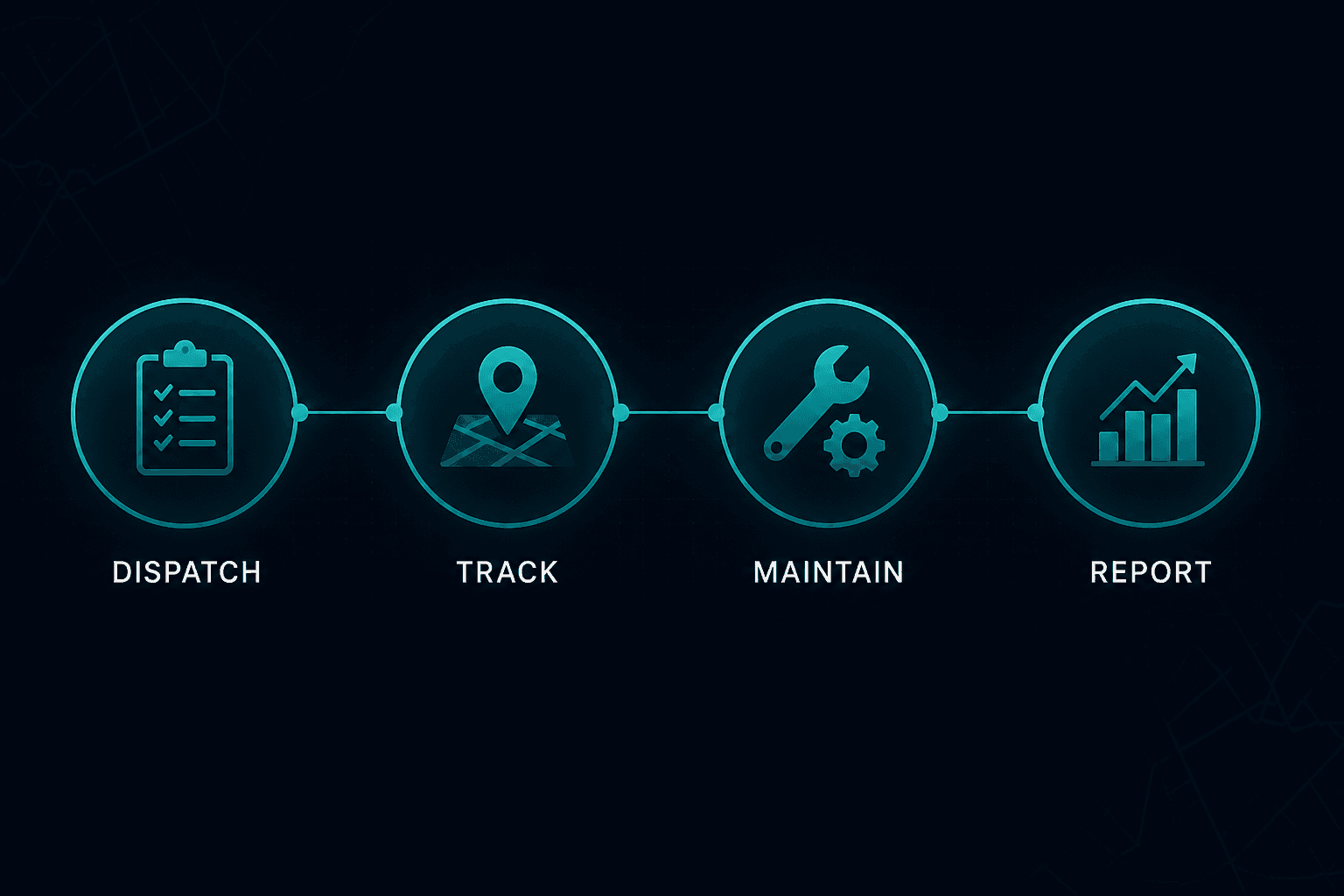
A serious platform usually spans four loops:
- Dispatch jobs to the right vehicle/driver
- Track execution in near real time
- Maintain assets before they fail
- Report cost, utilisation, and service levels
SectionCore Features Checklist
Dispatch and job management
Must-haves:
- job creation with locations, time windows, and priorities
- assignment by zone, skill, vehicle type, or capacity
- status flow: assigned, en route, arrived, completed, failed
- proof of delivery or service notes
- customer references and internal job IDs
Nice-to-haves:
- route optimisation suggestions
- recurring job templates
- multi-drop journey planning
- geofenced auto status updates
Live tracking and exceptions
Must-haves:
- live vehicle location and last-known ping
- breadcrumb history for disputes
- ETA visibility for ops (and optionally customers)
- exception alerts: idle too long, off-route, late job
Be careful with surveillance culture. Tracking should support service quality and safety, not distrust theatre. Communicate purpose clearly to drivers.
Maintenance and asset health
Must-haves:
- vehicle master profiles
- service schedules by mileage/time
- workshop job history
- tyre, battery, and inspection logs
- downtime reasons
If maintenance lives in a separate notebook, your "fleet system" is incomplete.
Compliance and documents
Depending on your operation:
- road tax / insurance expiry reminders
- licence and certification tracking
- inspection checklists
- incident and accident logs
- fuel card or fuel entry records
Singapore operators feel this pain when renewals slip and vehicles are grounded at the worst time.
Cost and utilisation reporting
Leadership usually wants:
- cost per job / per km
- vehicle utilisation
- on-time completion rate
- maintenance cost trends
- overtime and idle patterns
If the system cannot produce these without export gymnastics, reporting was an afterthought.
SectionOff-the-Shelf Telematics vs Custom Fleet Software
Choose off-the-shelf when
- your process is standard
- tracking and basic alerts are the main need
- you can adapt dispatch habits to the product
- integration needs are light
Choose custom or heavily customised when
- job types and SLAs are industry-specific
- you need deep links into ERP, WMS, or billing
- customer portals are part of the product experience
- drivers use specialised workflows (installation, collection, field service)
- packaged tools force parallel Excel processes
Related: custom software vs off-the-shelf solutions and field service management app Singapore.
SectionSingapore Operating Realities to Design For
Dense urban routing
Singapore routes are short, stop-dense, and sensitive to time windows. Software that assumes highway-long hauls may feel clumsy.
Customer communication expectations
Many B2B and B2C customers expect proactive updates. Build notification rules intentionally:
- job assigned
- driver nearby
- completed with POD
- delayed with reason codes
Multi-role usage
Your users are not one persona:
- ops controllers
- drivers / riders
- workshop staff
- finance
- account managers
Each needs a different interface. A single cluttered screen fails everyone.
Integration gravity
Fleet software rarely stands alone. Plan connections to:
- order management / ERP
- inventory or spare parts
- accounting for billing
- customer portals
- HR or contractor records
See API integration services Singapore and accounting software integration Singapore.
SectionA Practical Module Roadmap
Do not launch every module on day one.
Phase 1: Control tower basics
- vehicle and driver masters
- job assignment and status
- live map
- basic exception alerts
- daily ops dashboard
Phase 2: Customer and proof layer
- POD / photos / signatures
- customer notifications
- failure reason codes
- service history by customer
Phase 3: Asset economics
- maintenance schedules
- fuel and cost capture
- utilisation and KPI reports
- workshop workflow
Phase 4: Optimisation
- smarter routing suggestions
- zone balancing
- predictive maintenance signals
- deeper ERP automation
This phased approach matches how we deliver logistics software projects: prove daily control first, then optimise.
SectionData and Hardware Considerations
Telematics hardware
Decide early:
- OBD / installed GPS devices
- mobile-app-based tracking
- hybrid
Hardware reliability, SIM connectivity, and install logistics affect go-live more than UI colour choices.
Mobile reality for drivers
Driver apps must work with:
- one-hand use
- imperfect connectivity
- fast status updates
- low training overhead
- clear offline behaviour where needed
If drivers hate the app, ops will invent a parallel WhatsApp process by week two.
SectionCost Expectations in Singapore
Planning bands (software, excluding exotic hardware fleets):
Focused custom fleet ops module
About S$40,000 to S$90,000
Job dispatch, tracking views, statuses, basic reporting, one or two integrations.
Broader fleet + maintenance platform
About S$90,000 to S$180,000
Adds maintenance, richer alerts, customer communications, and deeper role workflows.
Enterprise logistics suite slice
S$180,000+
Multi-depot, complex optimisation, heavy ERP coupling, portals, advanced analytics.
Hardware, SIM plans, and mapping API costs sit on top.
For broader logistics context, read logistics software development Singapore. For build budgeting patterns, see custom software development cost Singapore 2026.
SectionBuyer Evaluation Scorecard
Score vendors or build partners on:
- Can they model your actual job types?
- Is the driver app usable in the field?
- Are exception alerts actionable, not noisy?
- Can finance get cost visibility without manual export chaos?
- How are integrations scoped and monitored?
- What does implementation and training look like?
- Who owns data if you switch later?
Ask for a workflow demo with your jobs, not a generic tour.
SectionImplementation Pitfalls
Tracking without process
GPS alone does not fix late jobs caused by bad dispatch rules.
Too many alerts
If everything is urgent, nothing is. Tune alert thresholds with ops leads.
Ignoring workshop workflows
Maintenance deferred is downtime scheduled by denial.
No adoption plan for drivers
Train, support, and simplify. Measure app usage in week one.
Reporting added last
If KPIs are undefined, you will not know whether the software worked.
SectionSample KPI Set for the First 90 Days
Define these before go-live so you can judge whether the software is working:
- percentage of jobs with on-time completion
- average minutes from job create to driver assign
- exception rate (late, failed, reassigned)
- proof-of-delivery capture rate
- vehicles overdue for maintenance
- share of jobs still coordinated outside the system
If more than a small minority of jobs still run through WhatsApp after 90 days, the issue is usually UX, training, or missing statuses, not "drivers hate software".
SectionHow SleekDigital Builds Fleet Systems
As a software development company in Singapore, we:
- map dispatch and exception paths before UI polish
- design driver and controller experiences separately
- integrate with order and finance systems intentionally
- phase modules so ops gains control quickly
- instrument KPIs from day one
We build for the way Singapore fleets actually run, not a generic global template.
SectionFAQ: Fleet Management Software Singapore
Do we need AI route optimisation on day one?
Usually no. Most operators gain more from clean job status, exception handling, and maintenance visibility first. Optimisation helps after the process is stable.
Can we start with a mobile app and no hardware GPS?
Yes for some fleets, especially if phones are always on duty. For higher-assurance tracking, dedicated devices are often better.
Should fleet software replace our ERP?
Rarely. Fleet software should orchestrate vehicles and jobs, then sync commercial outcomes to ERP/accounting.
How long does implementation take?
A focused Phase 1 can land in 8 to 14 weeks when requirements are clear and integrations are limited. Multi-depot maintenance-heavy systems take longer.
Is this relevant for field service, not just delivery?
Yes. Technician fleets share dispatch, tracking, proof, and maintenance needs. See also field service management app Singapore.
SectionFinal Take
Fleet management software pays off when it makes daily control boringly reliable: jobs assigned cleanly, exceptions visible early, assets maintained on schedule, and reports trusted by leadership.
If your fleet still runs on group chats and gut feel, contact SleekDigital to scope a phased system. Explore software development for logistics or our custom software development services to start.
Written by
Lester Law
Building custom software solutions for Singapore businesses. We help companies transform their operations with mobile apps, web platforms, and enterprise systems.