
Procurement Software Singapore: A Buying Guide for SMEs and Mid-Market Firms
Procurement software for a Singapore SME should do one thing well: move every purchase from request to payment with a named approver, a comparable set of quotes, a purchase order, a goods received note and an invoice that matches all three. Pick a procurement module inside your ERP if it already fits your approval rules, a packaged e-procurement SaaS if your process is standard, and a custom or AI-native layer only when supplier quotes, approvals or matching are where the hours go.
This guide is for distributors, manufacturers, contractors, F&B groups and facilities management firms. If you already know you want a supervised procurement workflow built around your systems, see procurement automation.
SectionThe procure-to-pay flow, step by step
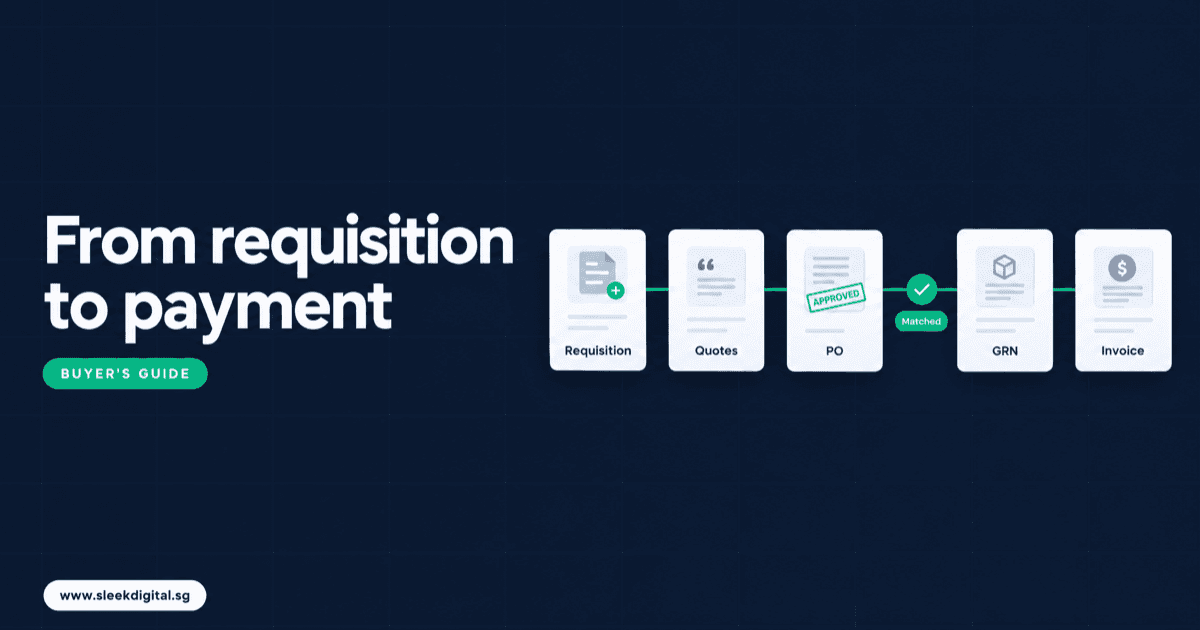
Every procurement system runs the same seven steps.
- Purchase requisition. A site supervisor, chef or storekeeper asks for something: 200 bags of cement, next week's dry goods.
- Approval. The request goes to the right person based on amount, cost centre and category.
- Supplier RFQ and quote comparison. For anything above a threshold, someone asks two or three suppliers for prices and compares them.
- Purchase order. The approved request becomes a PO with agreed price, quantity, delivery date and terms.
- Goods received note (GRN). The store or site confirms what actually arrived, including short deliveries and rejects.
- Three-way match. Finance checks the supplier invoice against the PO and the GRN. Price, quantity and item should agree within tolerance.
- Payment. Matched invoices go into the payment run. Mismatches go back to someone with a reason.
For services such as cleaning or maintenance there is often no GRN, so the check becomes a two-way match or a service acceptance.
SectionWhere procurement breaks in spreadsheets and WhatsApp
Most firms we scope have a process. It is just spread across a shared Excel, three WhatsApp groups and someone's inbox. The failure points are predictable.
- Requisitions arrive as chat messages. "Boss, need 50 more of the blue ones" has no item code, no cost centre and no record once the chat scrolls.
- Approval is a thumbs-up emoji. Nobody can later show who approved a S$18,000 order, or whether that person was allowed to.
- Quotes are not comparable. One PDF includes GST, one Excel charges delivery separately, a third quotes per carton. Comparing them takes an hour, so it gets skipped.
- POs are typed from scratch. Prices are retyped from the quote, which is where errors creep in.
- Invoices are matched by memory. Finance asks purchasing, purchasing asks the site, and the invoice sits for two weeks.
- Price creep goes unnoticed. A supplier raises a unit price by a few percent and nobody compares it with the last PO.
None of these needs a large system. They need one place where each step is recorded and the right person approves at the right threshold.
SectionThree ways to buy procurement software in Singapore
Option 1: The procurement module in your existing ERP or accounting system
If you run SAP Business One or a similar ERP, it almost certainly has purchase requests, POs, goods receipts and AP invoices. Accounting platforms often offer POs, but usually without requisitions, approval routing or GRNs.
This is the right start when approval rules are simple and the team already lives in the ERP. It struggles when requesters are on site or in a kitchen and will not log in to a desktop ERP.
Option 2: Packaged e-procurement SaaS (possibly PSG pre-approved)
Standalone e-procurement tools give you requisition forms, approval workflows, supplier catalogues, POs and basic matching out of the box, usually with a mobile app. Some vendors in Singapore are listed as pre-approved solutions under the Productivity Solutions Grant (PSG), which can reduce the cost of the subscription and setup. Check the current listing and terms on GoBusiness, since eligible vendors and support levels change.
This suits e-procurement for a Singapore SME with a standard flow. The limits show at the edges: unusual approval logic, messy PDF quotes, or an ERP the vendor does not integrate with.
Option 3: A custom or AI-native procurement layer
A custom layer sits on top of your accounting system or ERP and handles the parts that packaged tools do not: reading supplier quotations, routing approvals by your actual rules, drafting POs and matching invoices. It writes the final records back to Xero, QuickBooks, SAP Business One or a custom ERP, so the ledger stays where it is. That is what we build under procurement automation, and the integration side is covered in accounting software integration.
This makes sense when volume is high, supplier documents are messy, or approval rules are specific to your business (project-based contractors, multi-outlet F&B).
Comparison table
| Factor | ERP / accounting module | E-procurement SaaS | Custom or AI-native layer |
|---|---|---|---|
| Upfront cost | Low if you already own the ERP | Low, subscription based | Higher, project based |
| Time to go live | Weeks, mostly configuration | Weeks | 8 to 12 weeks for a first workflow |
| Approval rules | Basic to moderate | Moderate, configurable | Whatever your matrix needs |
| Mobile requisitions | Often weak | Usually good | Built for your users |
| Reading supplier PDF/Excel quotes | No | Rarely | Yes, with human review |
| Three-way match | Yes, on structured data | Basic | Yes, including messy invoices |
| ERP sync | Native | Depends on connectors | Built to your system |
| Grant route | Varies | PSG if pre-approved | EDG for qualifying projects |
| Best for | Simple, ERP-centric teams | Standard flows, smaller volume | High volume, messy documents, custom rules |
SectionWhere AI genuinely helps in procurement automation
AI helps where the work is reading, comparing and drafting. It is not safe where the work is deciding who gets the money.
Reading supplier quotations. A model can read a quote in PDF, Excel or email, pull out item, unit, pack size, price, GST treatment, delivery charge and validity, and normalise them into one comparison table. Teams skip this step today because it is tedious.
Flagging price changes against the last PO. When a new quote or invoice arrives, the system compares each line with the last agreed price for that item and supplier and highlights changes above a set tolerance.
Drafting POs from approved requisitions. Once a requisition and a supplier are approved, the PO draft is filled from the chosen quote: no retyping, with the source quote attached.
Matching invoices to POs and GRNs. The model reads the invoice, finds the PO and GRN, and proposes a match with differences called out (short delivery, price variance). Finance approves. This is the same capability described in invoice processing automation.
Where AI should not act alone
- Awarding suppliers. The cheapest quote is not always the right one. Reliability, credit terms, relationship and quality history are judgment calls for a buyer.
- Approving spend. The approval matrix exists so a named, accountable person signs off. A model can prepare the case. It does not press approve.
- Changing supplier master data. Bank details and payment terms stay with finance.
- Sending POs to suppliers. The draft can be ready. A person releases it.
This is the design principle behind everything we build: AI drafts, people approve. The detailed pattern is in our human-in-the-loop AI approval checklist.
SectionExample purchase requisition approval workflow
Below is an illustrative approval matrix by spend threshold. It is generic: your numbers, roles and categories will differ, and should come from your own finance policy.
| Spend per requisition (before GST) | Quotes required | Approver | Notes |
|---|---|---|---|
| Up to S$1,000 | None (approved supplier) | Department or outlet head | Recurring consumables from contracted suppliers |
| S$1,001 to S$5,000 | 1 written quote | Department head | Price checked against last PO |
| S$5,001 to S$20,000 | 2 written quotes | Department head, then finance manager | Quote comparison attached |
| S$20,001 to S$100,000 | 3 written quotes | Finance manager, then director | Reason recorded if cheapest is not chosen |
| Above S$100,000 | 3 quotes or tender | Two directors | Contract review before PO |
A good purchase requisition approval workflow also handles approvers on leave, split requisitions that dodge a threshold, overspent project budgets, and emergency purchases approved after the fact with a recorded reason.
SectionRequirements checklist for procurement software
Copy this into your requirements document and mark each line as must have, nice to have or not needed.
- Requisitions can be raised from a phone by site, kitchen or warehouse staff
- Approval routing by amount, cost centre, project and category
- Deputy and delegation rules for approvers on leave
- Supplier RFQ sent from the system, with replies captured against the request
- Side-by-side supplier quotation comparison (unit price, GST, delivery, lead time, validity)
- PO generated from the approved requisition and chosen quote
- GRN with partial delivery, rejects and photo of the signed delivery order
- Three-way match with configurable price and quantity tolerances
- Price change alerts against last PO
- Budget check against project or cost centre before approval
- Sync of suppliers, POs and bills to your accounting system or ERP
- Full audit trail: who requested, who approved, when, and what changed
- Role-based access, so requesters cannot see supplier bank details
- Data export, so you are not locked in
SectionVendor demo checklist
Bring your own documents and ask the vendor to run these.
- Give them three real supplier quotes in different formats. Ask them to produce a comparison.
- Raise a requisition from a phone as a site user. Time it.
- Show your approval matrix and ask them to configure it live, including a deputy rule.
- Split a S$12,000 order into two S$6,000 requisitions. Does anything flag it?
- Feed in an invoice with one line priced higher than the PO. What happens?
- Show the exact records that land in your accounting system or ERP, and what happens if the sync fails.
- Ask who owns the data, how you export it, and what it costs to leave.
- If AI is mentioned, ask what the model can do without a human approving it. The answer should be "nothing that commits money."
SectionWhat it costs
Packaged SaaS is priced per user or per month and is usually the cheapest start; PSG may reduce it if the vendor is pre-approved. ERP modules cost little extra if you own the licences, though configuration still takes time.
For custom work, our published scoping ranges are a guide, not a quote. A focused workflow module, such as quote comparison or invoice matching on top of your existing system, starts from about S$10,000. Broader custom software typically falls between S$30,000 and S$250,000+. If procurement is part of a wider operating system with inventory, sales and finance, a custom ERP typically runs S$50,000 to S$200,000 over 3 to 6 months, and an AI ERP S$50,000 to S$300,000+. A first AI agent for one procurement workflow is typically live in 8 to 12 weeks.
Qualifying SME projects may be up to 50% claimable under the Enterprise Development Grant, with eligibility decided by Enterprise Singapore. See our guide to EDG for software development.
SectionWhen off-the-shelf procurement software is enough
Be honest about your volume before you build anything. Off-the-shelf is enough when:
- You raise fewer than a few dozen POs a month
- Most purchases come from a small set of contracted suppliers at fixed prices
- Your approval matrix fits in two or three rules
- Your ERP module already covers requisitions and GRNs, and the real problem is that nobody uses it
Then configure what you have and enforce the process. Custom work pays off when messy quotes and invoices pile up, when approval logic is project or outlet specific, or when you buy raw materials against production schedules. Our manufacturing page covers that case.
SectionFAQ
What is the best procurement software in Singapore for an SME?
There is no single best option. If your ERP has a procurement module, start there. If you need mobile requisitions quickly, a packaged SaaS, possibly PSG pre-approved, is usually fastest. Consider custom only when documents, approval rules or volume exceed what packaged tools handle.
What is a three-way match?
A three-way match checks that the supplier invoice agrees with the purchase order (what you agreed to buy) and the goods received note (what arrived). If they agree within tolerance, the invoice is approved for payment. If not, it goes back with the difference called out.
Can AI compare supplier quotations automatically?
AI can read quotes in PDF, Excel or email and normalise units, GST and delivery charges into one comparison table. It should not choose the supplier. A buyer makes the award, with the reason recorded.
Does procurement software work with Xero, QuickBooks or SAP Business One?
Most packaged tools integrate with common accounting platforms; check which records sync and what happens when a sync fails. A custom layer can write directly to Xero, QuickBooks, SAP Business One or a custom ERP.
Is procurement software claimable under PSG or EDG?
Packaged solutions listed as PSG pre-approved can be supported under PSG, subject to current terms. Custom projects usually go through the Enterprise Development Grant, where qualifying SME projects may be up to 50% claimable. Enterprise Singapore decides eligibility in both cases.
How long does it take to implement a purchase order system?
Configuring a SaaS tool or ERP module typically takes a few weeks, mostly agreeing approval rules and cleaning supplier data. A first custom AI-assisted procurement workflow is typically live in 8 to 12 weeks.
Next step: If you want a written scope and quotation for your procure-to-pay flow, talk to us and bring three supplier quotes, one invoice and your current approval rules. You can also read how we approach procurement automation for Singapore firms.
Written by
Lester Law
Building custom software solutions for Singapore businesses. We help companies transform their operations with mobile apps, web platforms, and enterprise systems.