
An AI ERP performs operational knowledge work inside the workflow: drafting quotations, predicting inventory, classifying documents. A genuinely AI-native system inverts the old model: the system acts first and a person approves. That inversion is the line between a real AI ERP and a record-keeping system with a chatbot stapled on.
Almost every ERP vendor now claims AI. Most added a prediction widget to a record-keeping ERP and called it intelligence. This is the explainer: what AI-native ERP actually is, where agents deliver value, and how to evaluate before you spend. Custom builds live on our AI ERP Singapore service. For the buyer comparison, see AI ERP vs traditional ERP. ERP overview
S$50k–300k+
Custom AI-native ERP range
S$200–5k/mo
Off-the-shelf AI ERP subscriptions
Gen 3
Agentic, AI-native operating model
What is an AI ERP?
Every ERP was built to record what happened: sales, purchases, stock movements, payments. A ledger with screens. For forty years that was the job.
An AI ERP changes who does the work. When an enquiry arrives, the system reads it, matches catalogue items, pulls live stock and price history, and produces a draft quotation. The salesperson reviews and sends. The same shift applies across procurement, inventory, documents and reporting.
Adding a forecast dashboard or an chatbot is useful, but does not change who drives the process. A true AI-native ERP changes who drives.
Does the AI act and then wait for approval, or does it wait for a human to act?
Everything else is detail.
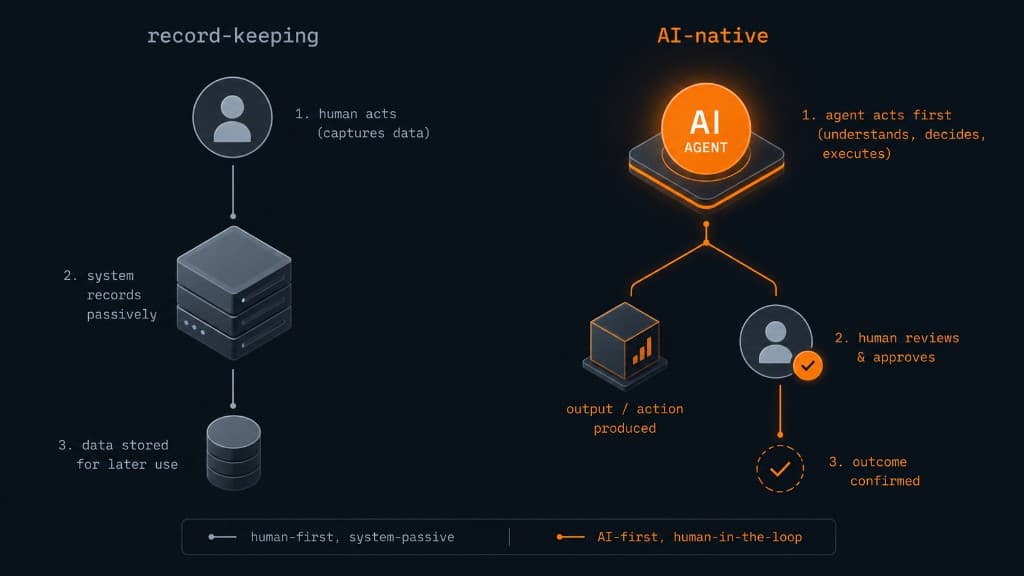
AI ERP vs a normal ERP with AI features
Nearly every vendor offers an AI assistant on top of an unchanged ledger. The matrix below is where the line falls.
Neither path is wrong. Simple operations may suit mainstream ERP with AI add-ons. Build vs buy covers when. Established firms doing hundreds of manual quotations per month only see the operational leap from the AI-native model.
The three generations of ERP
Most Singapore SMEs sit between Gen 1 and Gen 2 today. The valuable leap is Gen 2 to Gen 3.
Incumbent platforms were architected as ledgers. Most businesses at Gen 2 arrived via custom ERP development. The next step is layering agents on that foundation. If the ledger already works, wrap SAP B1, Xero, or a custom ERP instead of replacing it. For the buyer comparison, see AI ERP vs traditional ERP.
Where AI agents deliver value
Value appears at knowledge-work bottlenecks. In operations-heavy SMEs, the same agents recur:
None of these replace a person. Each removes a manual handoff. Capacity and throughput, not headcount. Agents are faster to build today via AI-assisted development.
Why this matters for Singapore SMEs
Singapore runs on established mid-sized firms in distribution, manufacturing, construction, logistics and trade. Many have capable but underused ERP, spreadsheets, and work held together by experienced staff. Manufacturing ERP guide
Labour is tight and expensive. The cost of building custom software has collapsed because AI does much of the coding. What stays scarce is understanding how a specific business actually works.
AI will keep making software cheaper to build. Understanding how a steel distributor or glass fabricator truly operates stays rare.
That is where the durable advantage sits.
How much an AI ERP costs in Singapore
Two paths, very different economics. Full bands are in AI ERP cost Singapore 2026. ERP cost guide · AI app cost guide
Off-the-shelf AI ERP subscriptions
Per-user or per-module pricing, typically a few hundred to a few thousand SGD per month. Suits standard operations. You adapt to the software. Custom vs off-the-shelf
Custom AI-native ERP builds
SGD 50,000 to 300,000 or more for established SMEs with complex operations, scaled to workflows, integrations and agents. The software adapts to you. ERP development service
Prerequisite · Map your operation before spending on either path, so the build is shaped by how the business runs, not a vendor default template.
How to evaluate before you buy
Any serious vendor can answer these plainly. Software company buyer's guide
- 01
Act then approve?
Does the AI act and wait for your approval, or only respond when a human acts first? Separates Gen 3 from a chatbot.
- 02
Concrete workflow
Ask for one specific industry workflow an agent runs end to end. Vague automation claims should resolve into an example.
- 03
Beyond spreadsheets
What does the system do that current ERP plus a spreadsheet cannot? Faster lookups is a feature, not a new operating model.
- 04
Operational map
Was your operation mapped before anything was proposed? Skipping the map is how builds disappoint.
- 05
IP ownership
Who owns the system and data at the end? Full IP transfer should be on the table for custom builds.
Engagement
Map the operation before you buy or build.
A proper operational map defines entities, workflows, approval chains and AI opportunities before code is written. It tells you what an AI-native ERP should do for your business.
Frequently asked questions
01What is an AI ERP?+
An AI ERP is an enterprise resource planning system in which AI performs operational knowledge work inside the business workflow, rather than only recording transactions after they happen. A genuinely AI-native system uses agents to draft quotations, predict inventory, classify documents and chase tasks, with people supervising and approving rather than performing each step by hand.
02What is the difference between AI ERP and a normal ERP with AI features?+
A normal ERP with bolt-on AI adds a chatbot or a prediction widget on top of a record-keeping system; the underlying workflow still waits for a human to act. An AI-native ERP is built around agents that act first and then wait for human approval. That inversion is what actually raises a team's throughput.
03How much does an AI ERP cost in Singapore?+
Off-the-shelf AI ERP subscriptions typically run from a few hundred to a few thousand SGD per month. Custom AI-native ERP builds for established SMEs with complex operations typically range from SGD 50,000 to SGD 300,000 or more, depending on the number of workflows, integrations and agents involved.
04Is AI ERP suitable for Singapore SMEs?+
Yes, particularly for established SMEs that have outgrown spreadsheets and find their existing ERP records data but does not move work. The highest returns appear in operations heavy in repetitive knowledge work such as quotation, procurement, inventory and document handling.
05Do I have to replace my existing ERP like SAP to adopt AI?+
Not necessarily. An AI-native layer can wrap an existing system such as SAP Business One, adding agents and workflow on top of the record-keeping foundation you already paid for, rather than ripping it out.
Written by
Lester Law
Building custom software solutions for Singapore businesses. We help companies transform their operations with mobile apps, web platforms, and enterprise systems.